
Every so often, after a comprehensive Celtic victory in a derby like last Sunday’s, I dip my toe into the other side’s mindset.
Simply because I want to see how they view it.
Today, I listened to the Heart and Hand podcast, and it made for interesting listening.
A lot of it was very balanced.
There is an acceptance there now that they just cannot compete with us.
However, they do not accept that their board is acting in the best interests of their club.
When their board actually is.
The biggest problem with the Ibrox support is that they cannot accept the days of big spending are over for their club.
They do not have the spending power Celtic has.

Therefore, their board has resigned themselves to the fact that trying to keep up is now a fool’s errand.
Whether they like it or not, their board is acting in the best interests of their club.
Maybe some day they’ll realise that, but right now, that day is a long, long way off.
In an article a few weeks back, I stated that it would take the Ibrox side 30 years to get to where we are now.
This is a fact.
Because that’s how long it has taken for us to become as strong as we are now.
So, for the current Ibrox board, they are either all in on this, or they can revert to type amidst the pressure from their fanbase.
Reverting to type will kill them, so they are really left with no choice but to follow this path.
They have to ride out the current storm of fan rage.
This will eventually dissipate, and will probably result in resignation and apathy.
Which in turn will result in half empty stadiums as Celtic continue to dominate.

Regardless, they either commit to this path or they don’t.
Right now, it looks as if they are.
I would use the saying “short term pain for a long term gain”, but in their case its really “long term pain for a long term gain”.
And I’ve already explained what long term looks like.
Since Sunday’s game, there has been a lot of talk about how the fixture between us and them has just become another fixture to negotiate for us.
No different to playing Hearts or Aberdeen.
My most recent articles on Monday and Tuesday have focussed very much on this subject.
To most Celtic fans, the Glasgow derby as a spectacle is now dead, just like the O** F***.
Now, I don’t mean the derby itself is dead, I just mean the spectacle.
It will always be a derby, as we hail from the same city.
Same as it will be a derby when we play Partick Thistle, or Queen’s Park, if either ever make it to the Scottish Premiership in the near future.
No, what I’m talking about is the spectacle the Glasgow Derby once was.
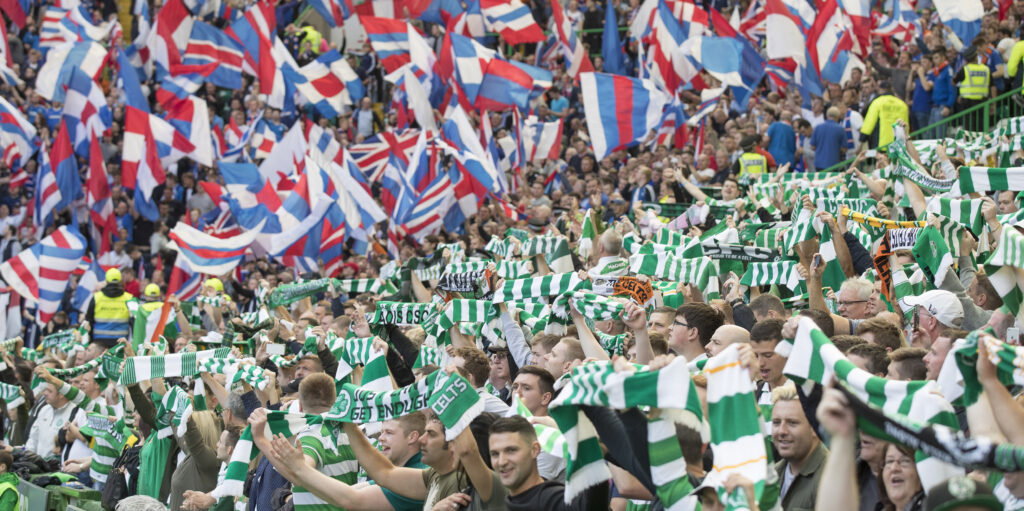
Back in the days when 7,500 fans of either side were allowed to attend this fixture at Celtic Park and Ibrox.

The colour and atmosphere that this fixture created was unique.
It was what made it so appealing world wide.
That all came to an end on March 11th, 2018.
After Odsonne Edouard scored a spectacular goal to win a pulsating derby for ten man Celtic.
The glib and shameless liar decided that it was time to lock Celtic fans out of Ibrox.
Simply because they could not handle our celebrations in the Broomloan End as we secured victories there with unerring regularity.
From then on, a paltry 750 tickets were allocated to Celtic fans wishing to attend the fixture.
We were herded into a corner, where we had cups of piss, bottles, abuse, and much more hurled at us.
Celtic fans had their heads split open, and on one occasion, a bag full of assorted weaponry, including a baseball bat, was found when the Onion Bears were given access to the stadium to set up a Tifo.
There was little or no regard for the safety of the miniscule amount of away fans permitted to attend the fixture.
In return, Celtic reciprocated the gesture, only allowing the same amount of fans in Celtic Park.

It was simple really, if they allowed 7,500 into Ibrox, then we would match that and allow the same amount to attend Celtic Park.
So when it became 750, well, that was exactly what Celtic would allow to attend at Celtic Park.
During the back end of Covid, no away fans were allowed to attend the fixture.
Celtic then refused to accept their allocation on safety grounds.
This was due to what happened in the January 2023 fixture at Ibrox.
This has ultimately killed the real raw and passionate atmosphere this fixture used to produce.
If Celtic had the upper hand in a game at Celtic Park, the away fans would fall silent.
Likewise, if the Ibrox side had the upper hand, the home fans would go quiet, and the away support would generate noise and atmosphere.
It was what made the fixture.
It was what contributed to the tension, and passion at these games.

Make no mistake, none of this was Celtic’s doing.
Celtic did not initiate this, nor did they agree with it.
The domino effect of this has wrought destruction throughout the game in Scotland.
The insanity of it has taken on an altogether contagious guise in the Scottish game.
For some unknown reason, defying all logic, other clubs decided to follow suit.
Kilmarnock started to cut away allocations at Rugby Park.
Stating they wanted to give preference to their own fans over large travelling supports like ours and the Ibrox club’s.
But this was financially to the detriment of their own club, as their own fans rarely, if ever, fill their stadium.
As a result, we were met with the diabolical optic of thousands of empty seats, which inexplicably was screwing Kilmarnock out of the much needed revenue they could gain if those seats were full.
It just made no sense.
But the madness spread.
Next to follow suit was Hearts, cutting the away allocation for our club to just 500 fans.

Once again, we were met with the sight of the Roseburn end half empty, and 500 Celtic fans crammed into the far right corner.
Huge advertising banners were being draped over all of the seats devoid of cash paying fans.
Most recently, Hibernian decided to cut allocations, once again leaving empty seats, rather than reaping the cash reward of filling them.
It is the epitome of cutting your nose off to spite your face.
It makes no fiscal sense whatsoever, and I really struggle to wrap my head around it.
Now, you may think I’ve gone off on a tangent here, but there’s method to my madness.
Back in 2018, the Ibrox side started something which feeds into where they find themselves today.
They were the ones who killed the Glasgow Derby as a spectacle, nobody else.

They cling to the notion that it is still the O** F***, but they also killed that when their old club died.
The reason that it has become just another fixture for us is because they made it that way.
Once upon a time, they were the only club that was permitted to bring an away allocation of 7,500 fans to Celtic Park.
No other club in Scotland could bring that size of an allocation to our ground.
In turn, their actions in locking us out of Ibrox caused a trend which has hurt their fanbase just as much as ours.
Both sets of fans now find themselves suffering from reduced allocations at other grounds like Rugby Park, Tynecastle, and Easter Road.
And while by next spring we might see 2,500 away fans permitted to attend Ibrox and Celtic Park, it will still never be the same fixture it was.
The Ibrox side’s actions in 2018 have had a huge knock on effect in the ensuing 6 years since then.

They have reaped what they’ve sown, and their own fanbase has suffered as a result.
They seem upset by the fact that we are stating our games against them are just another routine Scottish Premiership fixture, but they fail to understand that they played a huge part in it becoming that.
Would 7,500 Ibrox fans at Celtic Park last Sunday have made a difference to their performance?
We’ll never know, because we’ll never see it again.
But we’ve seen the kind of difference it made to Celtic at Ibrox.
Whatever way you look at it, having a good chunk of your support behind you spurs you on.
It helps you raise your game.
Celtic fans say that it was a party atmosphere at Celtic Park last Sunday, and it was.

We knew we were the superior outfit, and our fans went there expecting to beat them.
But whether you accept it or not, any football team will feel at a disadvantage if they have no supporters at a ground to roar them on.
It is an inevitable setback.
And when you are the underdog, even more so.
This is what makes it just another fixture for us.
We have a vociferous full house behind us, and we are the superior team.
There is no advantage whatsoever to the away team.
An away support might give them one, however slim that may be, it would still help.
When we go to Ibrox, while we would love to have a full Broomloan End roaring us on, what gets us through that fixture more often than not is our superiority.
We are simply better than them.
But by doing what they did in 2018, they took away what slim fighting chance they might have had when they came to Celtic Park.
The stats don’t lie.
They have one won game at Celtic Park since 2018 outside of their Covid victory in October 2020, when the ground was empty.
Not only did they kill the chance they had of securing any points at Celtic Park, they have also killed what was once the considered the most intense derby in World football.
That intensity was epitomised by the spectacle of the rivalry, and passion displayed by both sets of fans.
It is no longer the spectacle is was, and its unlikely it ever will be again.
Even at 2,500 fans, it still won’t be anywhere near the same.
The Ibrox side made the Glasgow Derby a routine fixture to us in part by their actions of 2018.
Since then, they have been the only real losers in all of this.
And they’ve reaped exactly what they’ve sown.




Comments.
Loading comments…