
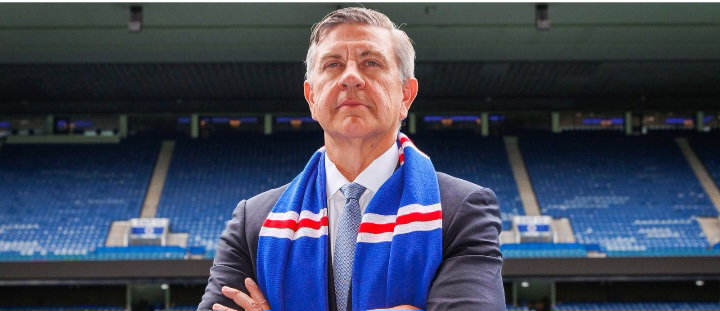
There are certain words that should send a shiver down the spine of anyone associated with Rangers Football Club.
Financial restraint. Share issues. Investors growing tired of writing cheques.
And after what happened at Ibrox in 2012, you would imagine those words might carry particular significance.
Yet here we are again, listening to another Rangers chairman explaining why the money cannot keep flowing indefinitely.
For Celtic supporters who remember the financial scandal that engulfed the old Ibrox club, the irony is impossible to ignore.
Rangers’ Financial Reality Comes Knocking
Chairman Andrew Cavenagh has warned supporters not to expect significant January transfer activity.
More revealingly, another share issue will be required later this season.
And despite the wealthy American investors behind Rangers, Cavenagh has acknowledged that continually writing cheques makes securing a return on investment increasingly difficult.
That is quite an admission.
Because Rangers supporters have been sold another vision of wealth, ambition and a glorious new era.
But wealthy owners do not automatically create a financially sustainable football club.
Surely Ibrox, of all places, should understand that by now?
Never Forget What Happened in 2012
Let’s get something absolutely straight.
The old Rangers company was not simply demoted because Scottish football decided to punish an otherwise healthy club.
It entered administration in February 2012, failed to secure a company voluntary arrangement and subsequently went into liquidation.
Its business and assets were transferred to a new company, which was admitted to the fourth tier of Scottish football.
That is the documented history, regardless of how anyone chooses to describe the club’s sporting continuity.
And then there were the EBTs.
For years, the old Rangers company used Employee Benefit Trust arrangements to provide substantial payments to players and other employees.
Separate side letters detailing financial entitlements were not disclosed to the football authorities, breaching registration rules.
The Supreme Court eventually ruled in 2017 that the payments constituted taxable earnings.
We are talking about a scheme involving tens of millions of pounds.
The football commission imposed a £250,000 fine but declined to strip titles, concluding that an unfair sporting advantage had not been established.
I respect that this was the commission’s ruling.
But I am entitled to question how undisclosed financial arrangements of that magnitude could ever have been allowed to continue for so long.
Celtic Fans Have Every Right to Remember
Let’s be clear about something else.
I am not suggesting Rangers’ current owners are repeating the misconduct of the old company.
There is no evidence in Cavenagh’s comments to justify that accusation.
But when the chairman of a club with that financial history discusses another share issue and the limits of investor funding, scrutiny is entirely justified.
Celtic have their own problems, particularly the failure of Dermot Desmond and the board to invest more ambitiously in the playing squad.
I will continue to criticise that.
But Celtic’s financial strength did not emerge from undisclosed side letters or a failed company rescued from liquidation.
The Question Rangers Cannot Escape
Rangers supporters can celebrate wealthy American backers and talk about closing the gap all they like.
But money must eventually come from somewhere.
If European income disappears, recruitment costs continue and investors expect returns, what happens when the next cheque becomes harder to justify?
That does not mean another collapse is inevitable. It means financial sustainability matters.
And perhaps the greatest irony of all is that Rangers have already lived through the consequences of getting their finances catastrophically wrong.
The old company went into liquidation in 2012. No amount of rewriting history will change that fact.
Celtic supporters haven’t forgotten.
And Rangers’ latest financial admissions provide another timely reminder of why they never should.










Comments.
Loading comments…