
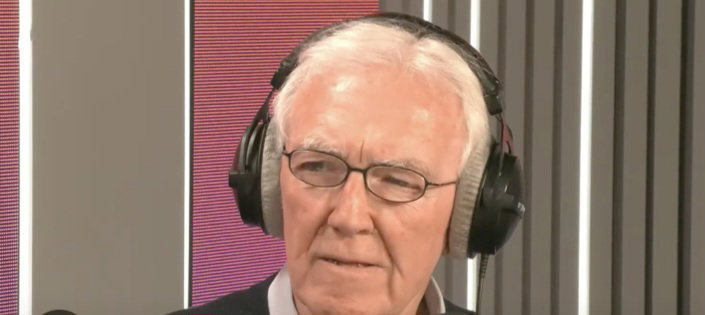
Hugh Keevins Celtic Fan Ban Claim Is Demolished by the Facts: This Is Not “Both as Bad as Each Other”
The Hugh Keevins Celtic fan ban argument on Clyde 1 Superscoreboard tonight was extraordinary.
Keevins’ position was essentially that Celtic and the Ibrox club are “both as bad as each other”.
That might make a convenient radio soundbite. It does not survive a serious examination of what actually happened.
Nobody should defend Celtic supporters entering the Ibrox pitch after March’s Scottish Cup victory. The independent Blackbourne review described that pitch incursion as “wholly inexcusable”.
Absolutely right.
But acknowledging Celtic wrongdoing does not mean pretending everything that followed was equivalent.
Celtic fans are not angels — and nobody should pretend otherwise
This needs to be said clearly.
Celtic supporters are not blameless, and they are certainly not angels.
Supporters entering the pitch was wrong. Graffiti, vandalism or destruction of property is also unacceptable. If Celtic supporters damage seats, toilets, walls or anything else belonging to another club, it should be condemned.
There should be no excuses because somebody happens to be wearing green and white.
Celtic supporters should be judged on their own behaviour and punished appropriately when they cross the line.
But that principle has to work both ways.
And this is exactly where Keevins’ “both as bad as each other” argument falls apart.
There is a substantial difference between damaging property and deliberately confronting or attacking people.
That distinction matters.
Hugh Keevins ignores the most important difference
Celtic supporters entered the field celebrating a dramatic penalty-shootout victory.
What happened afterwards became considerably more sinister.
The independent review records sections of the home support breaking through police and stewarding lines.
More seriously, it records masked home supporters carrying poles and wearing reinforced gloves as the situation moved dangerously close to a mass confrontation.
The report concluded there was a period when life-threatening violence was possible.
That cannot simply be reduced to: “Both sets of fans ran onto the pitch.”
Context matters. Intent matters. Severity matters.
Running onto a football pitch to celebrate is wrong.
Running towards other people masked and apparently equipped for confrontation presents an entirely different level of danger.
That is the distinction Keevins’ argument wipes away.
It is not balance. It is false equivalence.
This ticket dispute did not begin with Celtic
The history matters too.
The modern away-allocation dispute did not start because Celtic suddenly decided they no longer wanted visiting supporters.
In 2018, the Ibrox club unilaterally slashed Celtic’s allocation from roughly 7,000 tickets to around 800.
Celtic subsequently reciprocated.
That chronology is documented.
Brendan Rodgers later made the point perfectly: this originated as an Ibrox club decision before Celtic became dragged into an arrangement routinely portrayed as though both sides created it simultaneously.
Now we have another chapter.
The Ibrox club proposed an allocation of only 300 Celtic supporters for the forthcoming Premier Sports Cup meeting.
Celtic rejected that proposal and referred the matter to the SPFL.
Yet once again, the eventual narrative becomes that “both clubs” cannot behave themselves.
That is far too convenient.
The history at Ibrox cannot simply be erased
There is also a disturbing list of previous incidents involving Celtic at Ibrox.
In 2017, a supporter entered the pitch and confronted Scott Brown.
In 2022, broken glass was thrown into Joe Hart’s penalty area, forcing a delay while the surface was cleared.
During that same fixture, Celtic staff member Danny Friel was struck by a bottle and required stitches.
In January 2025, Arne Engels was struck above the eye by a coin while taking a corner.
Again, these are not arguments that Celtic supporters are perfect.
They plainly are not.
But journalists have a responsibility to examine individual incidents rather than throwing everything into the same convenient Glasgow football melting pot.
Celtic graffiti should be condemned.
Celtic vandalism should be condemned.
Celtic supporters entering the pitch should be condemned.
But violence directed towards players, staff or other supporters must also be described for what it is.
And it cannot be sanitised simply to maintain the comforting media line that everyone is “as bad as each other”.
Keevins’ argument is therefore not persuasive balance.
It is lazy equivalence.
Judge Celtic on Celtic’s wrongdoing.
Judge the Ibrox club and its supporters on theirs.
That would be fair.
Pretending the evidence shows exactly the same behaviour from both sides is not.






Comments.
Loading comments…