
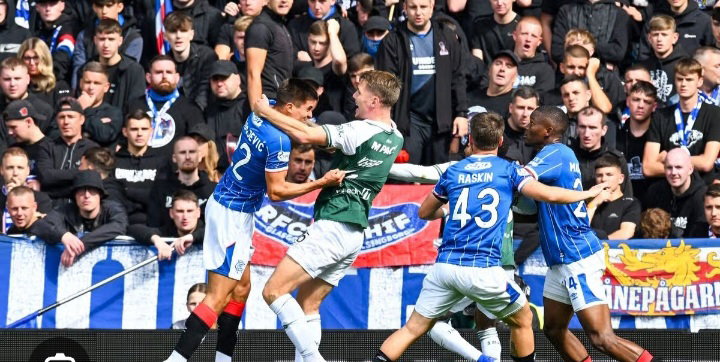
The Hibs penalty outrage at Ibrox is beginning to look increasingly difficult to sustain.
Andy Walker and Mark Guidi have provided crucial context surrounding the controversial decision. Remarkably, even Kris Boyd has now backed up the central point.
The clubs had already been told how this type of incident would be treated.
So why the outrage?
Walker and Guidi explain the Hibs penalty
Walker and Guidi discussed the penalty on Go Radio following Hibs’ victory at Ibrox.
Their explanation cuts straight through much of the noise surrounding the decision.
Walker revealed:
“This incident here at the weekend was highlighted in a meeting…”
That is a hugely important detail.
The penalty was therefore not based on some interpretation suddenly invented during the match. This type of challenge had already been highlighted and the refereeing approach explained beforehand.
Guidi also discussed the reasoning behind the decision alongside Walker.
The important distinction concerns whether a defender is genuinely challenging for the ball or concentrating entirely on his opponent while holding, blocking or making illegal contact.
Simply taking your eyes off the ball isn’t automatically a foul.
However, doing so while grappling with an opponent can help officials determine whether the defender is making a legitimate attempt to play the ball.
Even Boyd backs up the explanation
Then comes perhaps the most awkward part for those still raging about the Hibs penalty.
Kris Boyd has effectively backed up Walker and Guidi’s explanation.
Discussing the refereeing guidance, Boyd referenced defenders “not looking at the ball” and explained that officials had been told they would be penalising this type of incident.
Even Boyd, a former Ibrox striker, therefore understands why the penalty was awarded.
He doesn’t need to like the interpretation for his comments to matter.
The crucial point is that Boyd’s account supports what Walker and Guidi have already explained.
Officials had been briefed. This type of incident had been highlighted. Clubs knew about the refereeing approach before the controversy erupted.
The existing law remains straightforward. Holding an opponent or impeding an opponent with contact can result in a direct free-kick. Inside the penalty area, that can mean a penalty.
Walker explains it. Guidi discusses the reasoning. Even Boyd confirms officials had already been told such incidents would be penalised.
Three prominent pundits pointing towards the same conclusion.
Perhaps the biggest problem with the Ibrox outrage is remarkably simple.
They had already been told.
Celtic fans are watching.






Comments.
Loading comments…