
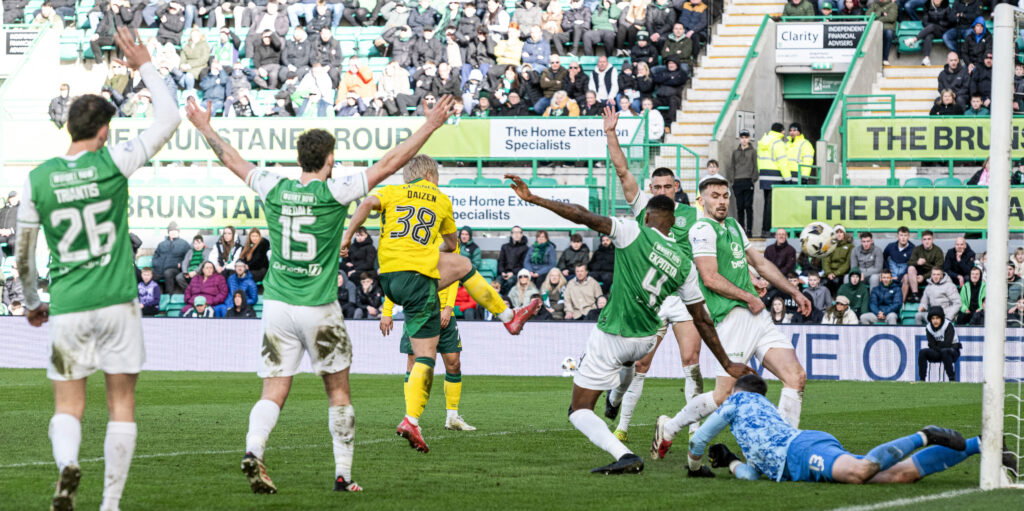
So, the SFA’s Key Match Incident panel have “overwhelmingly determined” that Daizen Maeda’s equalising goal for Celtic in the 2-1 loss to Hibs should have been allowed to stand.
The fact that they have determined it should have been a goal leaves more questions than answers.
We discussed this decision on our podcast last Sunday evening, and to be honest the fact that the KMI panel said it should have stood is staggering.
It’s staggering because the decision making process that was used at the time to disallow the Celtic goal was illegitimate.
For the following key reasons:
It is not the VAR’s job to overrule both the linesman and the referee’s decision, both had ruled that it was a goal.
The VAR is the Video Assistant Referee, but in Scotland it appears he is the VR, Video Referee, and the men on the pitch are HIS assistants.
Alan Muir’s intervention was illegitimate because he did not have the technology on hand to fully determine the ball had fully crossed the line.
Therefore, by default, the Referee and the linesman’s decision to award the goal should have been the determining factor in all of this, as they were best placed to make that call.
Alan Muir did not have access to Hawkeye technology, so he could not clearly see whether the ball fully crossed the line or not.
All of the above factors point to one thing.
Muir took it upon him self to disallow the second goal because he wanted to disallow it.

If Muir has nothing to hide in all of this, then the SFA should release the audio of the incident to Celtic to clarify the thought process behind his decision.
In fact, they should have no issue whatsoever with releasing it.
Celtic should also seek clarification on who has the final say when it comes to decision making like disallowing a goal.
For example, when a serious foul has occurred, the VAR calls the referee to the monitor to make the final call on whether he thinks it was a red card offense or not.
The final decision lies with the on-field referee.
Which would lead you to believe that he is the one in-charge.
The same applies when the VAR sees a possible penalty, the final decision lies with the on-field referee.
We saw this, to our detriment at Celtic Park against Bayern Munich, when the on-field referee decided that Dayot Upamecano’s foul on Arne Engels was not a foul after all.

Therefore, if Alan Muir thought the ball was out of play, should he not have called the on-field referee, Steven McLean, to view the same footage he was looking at?
However limited it was?
McLean then could have said that he could not make a definite call based on the footage he could see, so he was going with his original on-field call, and allowing the goal to stand.
Why did that not happen?
Why did McLean just accept Muir’s decision when the final call should lie with him?
These are the questions Celtic should be asking, and demanding answers to.
Because today, the fact that the KMI panel determined that Celtic’s second goal should have stood, well, like I said, it presents more questions than answers.
The main one being Muir’s decision to take it upon himself to disallow what has now been proven to be a perfectly legitimate goal.
I’m sure Celtic will be demanding answers to all of these questions.
Because that was no blunder.
But I think we all know that.
Don’t we?






Comments.
Loading comments…