
So the Record has confirmed what we pretty much already knew today, that Celtic DID make several bids for Mathias Kvistgaarden on deadline day.
All of which were of the lowball variety
As the headline in this article suggests, the word “lowball” and the method of “lowballing” is becoming synonymous with Celtic.
So much so, that I wouldn’t be surprised if the Oxford dictionary changed it’s definition to what is stated in this article’s headline.
But here’s the thing.
What is becoming more and more abundantly clear is that the method of lowballing clubs for their players, especially on deadline day, DOES NOT work.
The evidence is there for all to see.
Celtic did not acquire a striker in the window just closed.

Despite making several offers, as quoted by the Brondby Chairman, Jan Bech Anderson, we did not manage to secure the signing of Kvistgaarden, our long-term striking target.
Here is what Bech had to say:
Yes, we turned down offers – concrete ones and less concrete ones. There were never any numbers that made us deviate from our plan not to sell him in this transfer window. They weren’t good enough, but hopefully it will be when the time is right for him and the club. It was 100 per cent a goal for us to keep him for the rest of the season. There have been many enquiries about him – on the last day and the penultimate day of the transfer window.
The key take-out from that commentary from Bech is this; There were never any numbers that made us deviate from from our plan not to sell him in this transfer window.
Crystal clear confirmation that lowball offers were made for the player.
Now, the more I think about this, the more I delve into how this lowballing comes about.
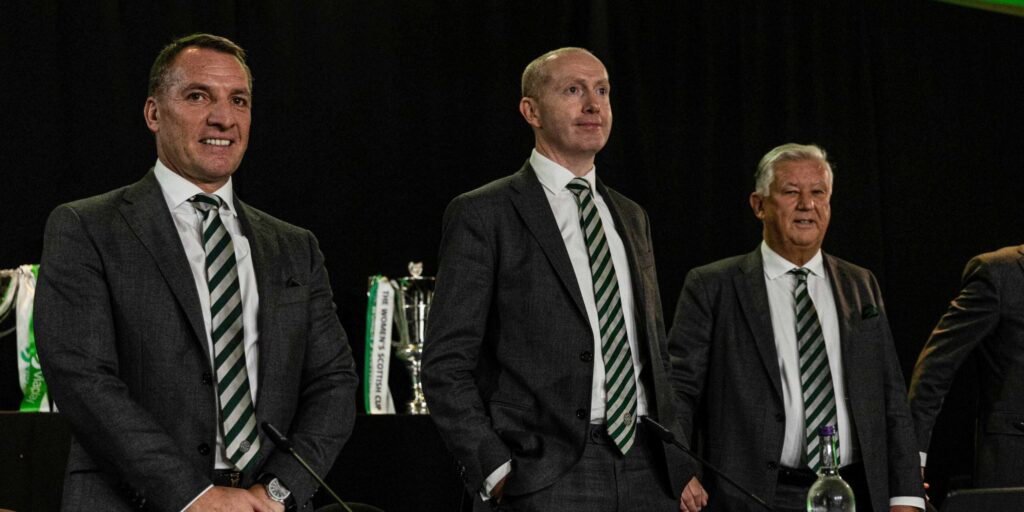
Put it this way, Brendan Rodgers made it clear he wanted a striker.
Kvistgaarden was one of his specified targets.
Brendan Rodgers does not come up with the figures we should offer for our targets.
He gives his recommendations to the board detailing what he requires.
When an initial approach is made to a club, somebody at Celtic HAS to come up with an opening number.

So who comes up with that number?
Chris McKay is the finance man, so is it him?
Michael Nicholson is the CEO, so could it be him?
Peter Lawwell is the man MOST experienced in these dealings, so is it him?
And by MOST experienced, I mean he is the master of the lowball method.
Reference John McGinn 2018.
Enough said.
On Monday, I published in article which contained commentary from the Motherwell CEO, Brian Caldwell, on a lowball, or derisory offer as he termed it, for Lennon Miller.
Here’s what he said:
To be bluntly truthful, we’ve had a couple of offers from a club who are miles away from that valuation of what we would deem Lennon Miller to be selling.
We are not desperate to sell the player.
Brian Caldwell might not have named the club who made the offer, but I think it’s pretty clear what he was intimating.
They were lowballed.
You don’t have to be a genius to figure out who it was that lowballed them.

The more you look, the more a pattern emerges here.
Then you have the David Strelec story.
It is stated that we were priced out of a move for the Slovan Bratislava player.
Another club came in and clearly bid more than Celtic did.
Celtic weren’t willing to match that offer of £9 million.
The player was valued at around £8 million.
You can be pretty damn sure Celtic didn’t offer the asking price for him.
I’d be confident they came in with a lowball offer of somewhere between £5 and £6 million.
So I’m putting it out there now, we didn’t land a striker, or Lennon Miller for that matter, because we lowballed the clubs we approached.
None of them were interested in what we had to offer.

This is a big part of the reason we did not replace Kyogo Furuhashi.
Now this happens so many times, you begin to wonder whether it’s by design or through sheer stupidity that we continue to do this?
Because it does NOT work.
Clearly it doesn’t.
Proof positive that it doesn’t is the Adam Idah shambles last summer.
We lowballed Norwich with a derisory offer, which in the end, resulted in us having to pay way over the odds for him.
So, as I alluded to earlier, only one of three men can continuously be making the call to employ this method of bidding.
I would hazard a guess it’s the man who has employed this method the most in the past.
Well, it’s either him, or the CEO is seeking advice from him, and doing exactly what he’s advised to do.
But you have to assume that neither of these men are stupid.
Because to do the same thing over and over again, achieving the same results over and over again is to imply complete stupidity.
So therefore, it boils down to the fact that this is either being done through sheer stupidity or by design.

And as I’ve said, neither of these men are stupid.
So that just leaves the other assumption.
It’s being done by design.
And this, to a degree, links in with what James had to say over on the Celtic Blog today.
You need to read the segment in James’ article where he refers to Graham Spiers podcast last night.
I’ll give you a small bit of insight on it.
The board believes they spent lavish amounts on players last summer.
In a window that was revenue neutral, and which posted a profit.
So no, they didn’t.
But that’s beside the point.
There is a belief there that because Rodgers left some of these high cost acquisitions on the bench for the home game last September against the Ibrox side, that certain members of the board were pissed at him for not playing them.
No prizes for guessing who.
Then there is this comment from James:
And maybe Spiers’ comments offer a little bit of insight as to why they might have resisted Rodgers’ demands during the window. I’m not saying that’s the reason, but it gives you a possible motive. They don’t think Rodgers has gotten enough use out of the players he’s already got. And it blows my mind to think that they have the balls to actually express that view to members of the media—or anyone else.
I’ve feel I’ve given a little more insight.
Somebody makes the call to continuously make these lowball offers.
Knowing that nine times out of ten, they’re destined to fail.
Thus resulting in the money there is such a reluctance to spend remaining in the club’s coffers.
Win/win for bean counters, not so good for the footballing operation.
I’ve given you three clear examples from just the last window.
I could give you a lot more from the past if you wanted them.
Is Brendan Rodgers being undermined here?
I’ll let you be the judge of that.
It doesn’t take a genius to see the patterns.
Patterns that we bloggers have been examining for years.
This is what we attempted to flesh out in last night’s podcast.
Take the time to listen to it.
There are some aspects to it which may open your eyes, and your mind.
If both have not been opened already.
YouTube: The Board Failed The Manager











Comments.
Loading comments…