
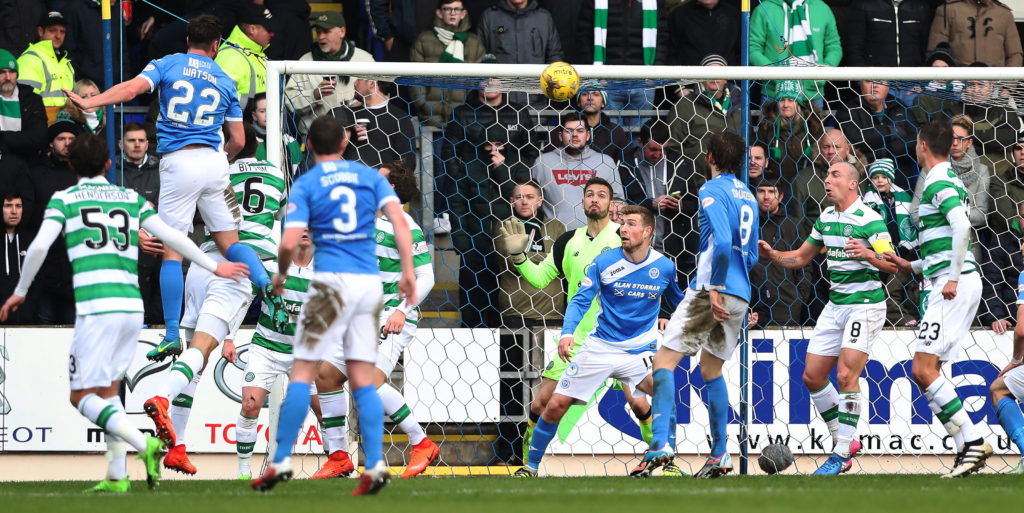
Celtic are flying high at the top of Scottish football, but there is one area this season which needs rectifying for a prolonged European campaign in the coming years – crossing. While the Hoops have enjoyed a barrel-load of goals this campaign and have only lost five competitive matches this season, they have conceded 18 goals from crossing scenarios out of the 39 goals they have conceded overall.
Whilst playing over 40 games this campaign, the Hoops have had their fair share of near misses along the way, from qualifying for the Champions League to their domestic unbeaten run. The domestic run stands at a staggering 29 games without defeat but if Brendan Rodgers’ side become complacent, teams could take advantage of them.

Rodgers inherited a squad which simply underperformed last season. The Hoops boss has produced a miracle at Celtic in his nine months at the club, and the Scottish champions are playing free-flowing attacking football again. It’s a joy to watch but as we are all too aware from the weekend, Rodgers knows there is still work to be done in the squad.
So, why are the Hoops having so much of an issue with crossing? The problem has been an occurring issue in the last few years and has cost the Celtic side on numerous occasions. While Rodgers prizes himself on high pressing, he may want to delve into the mind of the defence even more. After all, he had the same issues at Liverpool during his time there, so it’s a known issue in Rodgers’ teams.
The high pressing and attacking full back’s mean crosses can be launched into the box at will if players are out of position and can’t close them down, causing problems in the box for Celtic.
Jozo Simunovic, Erik Sviatchenko, Dedryck Boyata and Mikael Lustig have all played a part at the heart of the defence. While Kolo Toure and others have had brief stints at the back, it is they four who have featured in the central positions.

All four defenders offer something different and have their own unique qualities which makes them stand out but as a cohesive unit at times, the centre-backs are all over the place. At times this season they have been too far apart and this has allowed an opposition striker to have a chance on goal.
Rodgers may have imprinted his own philosophy in playing quick attacking football that has lit up the eyes of fans, but he is yet to find a formula which stops teams crossing the ball into the area with relative ease at times thus far.

As well as this, corners can be a real problem when we can’t defend the situation properly. Rodgers interestingly elects to put a player on one post and two attacking players stay up near the halfway-line to counter attack quickly.
Could this be something Rodgers wants to change? Possibly. For a lot of teams, having players on both posts does reduce the threat of a goal and leaving one man up can still provide an outlet on the counter attack. Certainly in European competition Rodgers won’t gamble as much as we do in the league.
It’s all about balance. Something which Brendan Rodgers has reiterated from day one as Celtic boss. Balance in the side means a good attacking display alongside a sturdy defence. Too much of each/either can lead to the side being too uneven and that’s when the opposition can pounce.

Whilst this season has been in another galaxy compared to last year’s campaign, I’m sure Rodgers and his backroom staff will want to reduce the high number of goals conceded by crossing to help build a resolute team capable of going beyond the group stages in the Champions League or going deep into Europa League competition.
With Celtic dominating domestically, it is only themselves that can stop them being invincible this season. Sunday’s match against St Johnstone was a small reminder that if there is a lapse in concentration, opposing teams will get their chance, and in Europe they will punish us more often. When we need to though, we can play some unstoppable football as we saw in the last 30 minutes on Sunday.











Comments.
Loading comments…