
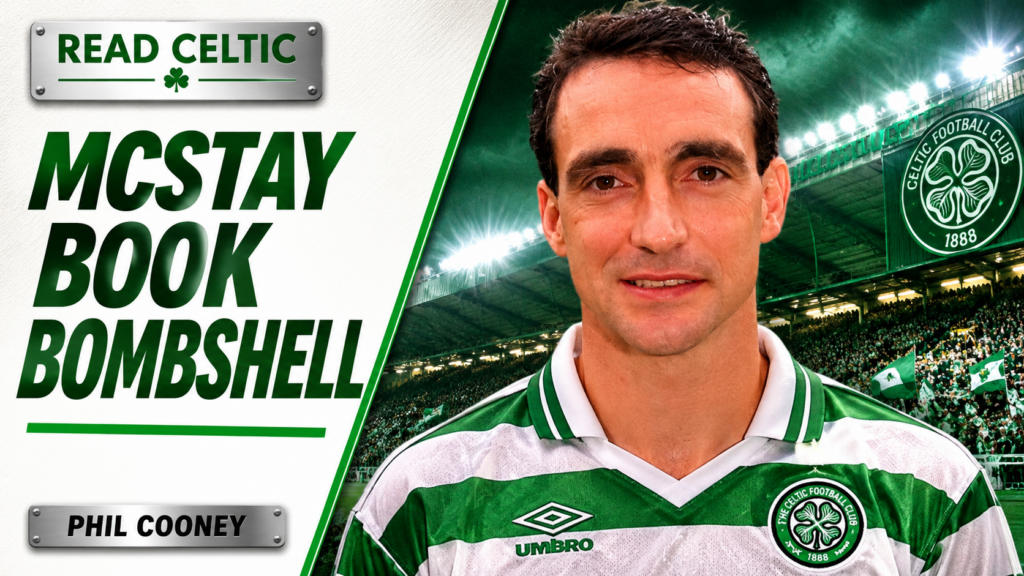
Celtic’s astonishing demand to Paul McStay – who the hell do this board think they are?
There are moments when you genuinely wonder just how far removed the people running Celtic have become from the club’s history, its supporters and everything it is supposed to represent.
Then along comes a story involving Paul McStay that leaves you absolutely speechless.
Celtic wanted approval over the contents of the Maestro’s autobiography.
Their approval!
Who the hell do they think they are?
According to The Scotsman’s interview with McStay, the club sent him an agreement that would have allowed Celtic to sign off on his book.
McStay refused.
And good on him.
The absolute arrogance of Celtic’s hierarchy
We’re talking about Paul McStay here.
The Maestro. A one-club man. A footballer who dedicated 16 years of his professional career to Celtic, carrying the hopes of thousands of supporters through some of the darkest years in our modern history.
A man who stayed loyal when he could have walked away.
Yet somebody representing Celtic apparently thought it appropriate to demand editorial approval over his personal memories.
The sheer arrogance is breathtaking.
McStay explained his position perfectly:
“It’s my book, my story, my life.”
Seven words that should embarrass whoever thought this agreement was acceptable.
Why should McStay require anybody’s permission to explain what happened during his own career?
He lived it. He earned the right to tell it.
What exactly were Celtic uncomfortable with?
The Scottish Sun’s account of McStay’s revelations confirms that certain aspects of his story made the club uncomfortable.
One particularly sensitive subject concerns his departure in 1997.
McStay believes the circumstances surrounding his retirement were not accurately represented at the time.
Now, almost three decades later, he wants to put his version on record.
And why shouldn’t he?
Importantly, McStay acknowledged that Celtic had been helpful and that good people work at the club. He wasn’t launching some personal vendetta.
He simply wanted control of his own autobiography.
That makes the request for approval even more extraordinary.
Celtic’s history belongs to its people
There is something deeply troubling about a football club wanting the final say over how one of its greatest servants tells his story.
Celtic’s history does not belong exclusively to the people sitting in the boardroom.
It belongs to the players who built it and the supporters who sustained it.
The current directors are temporary custodians. Paul McStay’s place in Celtic history is permanent.
And here’s the question I would put directly to the hierarchy.
What gives you the right to decide which parts of a Celtic legend’s life are suitable for publication?
This is precisely the sort of pompous, self-important attitude that has created such a disconnect between Celtic’s leadership and its supporters.
The Maestro owes nobody an explanation for refusing that agreement.
If anything, Celtic owe him one for presenting it.
Paul McStay gave Celtic his loyalty, his talent and the finest years of his footballing life.
He certainly doesn’t need the board’s permission to tell us about them.
Key takeaways
- Celtic sought approval over Paul McStay’s autobiography.
- The Maestro refused the proposed agreement and published independently.
- His account of his 1997 departure is an important part of the book.
- Celtic’s current leadership should remember that club legends do not answer to the board.
Further reading
Celtic’s Paul McStay leaves Desmond and the board facing questions












Comments.
Loading comments…